User query
"I run a small online business, and I'm ready to hire a bookkeeper who works remotely. Every candidate says they know QuickBooks Online. How do I tell who is actually good before I hand over my books?"
Most owners don't notice a weak bookkeeper for months. Invoices go out, bank feeds keep syncing, and everything looks fine until somebody asks for a number you can't back up.
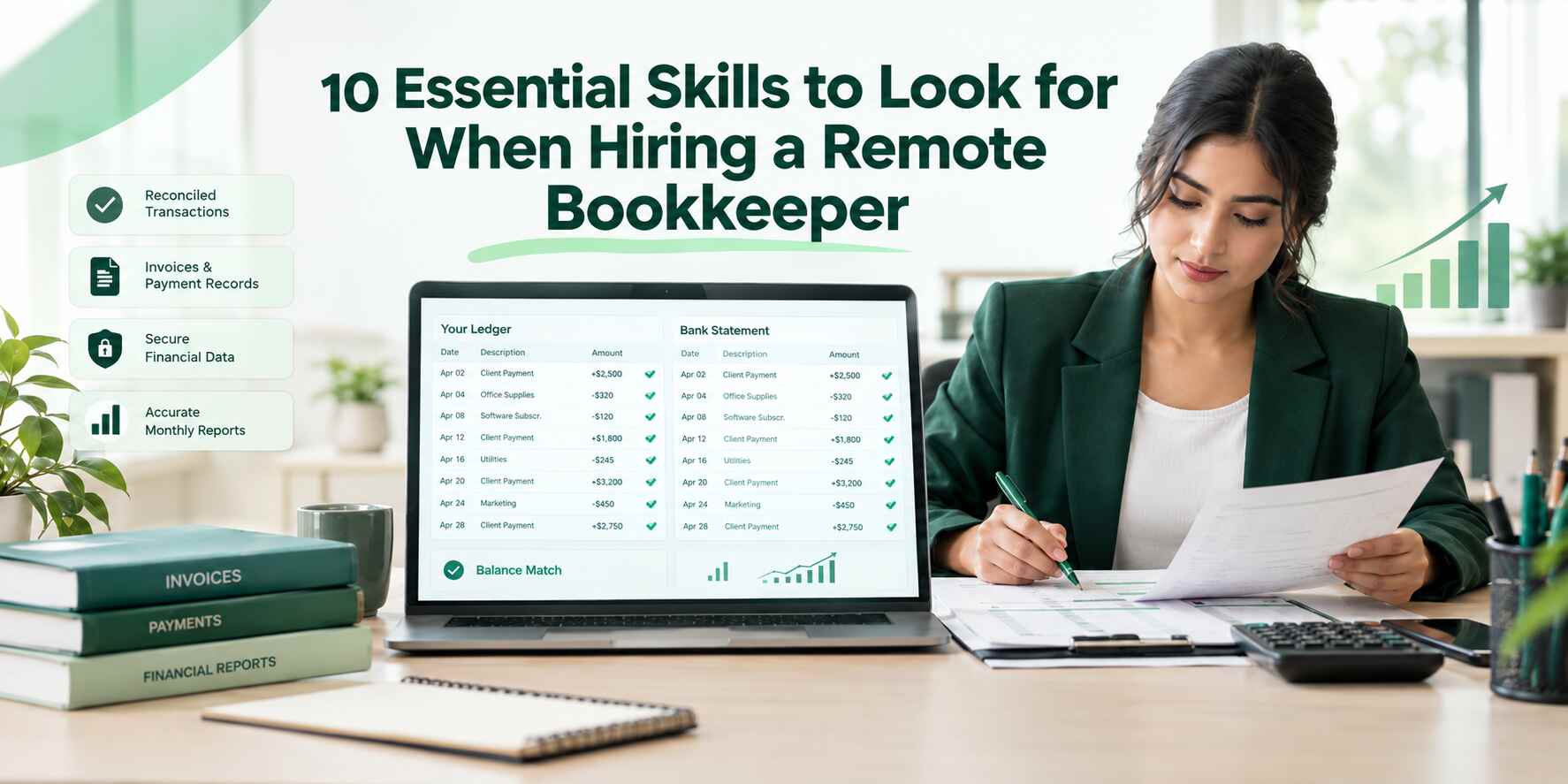
That's why choosing a remote bookkeeper matters more than the hourly rate. A CV that says "QuickBooks" proves very little. You need someone who can run your books in it, on their own, without making a mess you'll pay to untangle. Below are 10 skills worth checking — a cheap way to test each, the shifts that vary between the US, UK, UAE, Canada, and Australia, and where to find pre-screened people.
Quick answer: start by looking for real, hands-on QuickBooks Online experience, not just theory. How well do they balance the books? Are their reconciliations accurate? Can they wrap up the month-end close without drama? Add tax knowledge for your country, clear writing, and careful data-security habits.
The 10 skills every remote bookkeeper should have
1. QuickBooks Online fluency, not just familiarity
Everyone says yes to "do you know QuickBooks?", so skip that question. One simple way to get a feel for how well someone handles QuickBooks Online is to ask what they worked on last week. Did they set up bank rules? Create recurring invoices, or fix a feed that kept putting the same vendor in the wrong account? People who live in the software start talking happily. People who don't go vague.
2. Reconciliation accuracy
This is most of the job. Every bank and card account gets matched to its statement each month, and any gap gets chased down. The warning sign is a plug figure — a small "adjustment" that makes the difference disappear. If you spot one with no note on it, ask.
3. Control of payables and receivables
Two lists need watching: what you owe and what you're owed. Miss the first, and you pay late fees. Miss the second, and you're lending customers money for free. A decent online bookkeeper chases overdue invoices before you remember to.
4. A reliable month-end close
Get a date. "Reports by the fifth business day" is a real answer; "soon" isn't. Ask what happens when a receipt is missing, too. Something always is.
5. Tax awareness for your country
No, they aren't your accountant. Even so, UK books need someone who understands VAT returns, and Australian books need GST and BAS. A bookkeeper who has never touched either will cost your accountant hours of cleanup. Ask which filings they've actually supported.
Skip weeks of screening
Tell us your software and the filings you deal with. We'll send pre-vetted remote bookkeepers who've done the real work — profiles in 48 hours.
6. Clear written communication
Most of your contact will be typed, so the way candidates write to you during hiring is a preview. Short, clear, and specific is what you want. A muddled first email rarely turns into tidy month-end notes.
7. Data security habits
They'll see bank details, supplier payments, and sometimes payroll. Two-factor login, a password manager, and limited permissions should be normal for them. If anyone offers to send a password by text, that's the end of the interview.
8. Knowledge of your industry
Online shops deal with marketplace payouts, refunds, and fees taken before the money lands. Builders deal with job costing and progress billing. A virtual bookkeeper who has seen your kind of mess before catches odd numbers early. Otherwise, they just get posted.
9. Self-direction
Without being able to watch them work, their habits become crucial. Good ones stick to a routine, keep track of what they've finished, and give a heads-up if they think a deadline might slip.
10. Honesty about mistakes
Everyone slips now and then. I'd worry more about the person who never mentions one. Ask for the last error they caught and how they dealt with it. "I don't really make them" is your cue to keep looking.
How to test a virtual bookkeeper before you trust them
Interviews reward people who interview well, which isn't the same as people who reconcile well. A small paid test fixes that.
Set up a practice QuickBooks Online file with a month of messy transactions. Ask two or three finalists to categorise and reconcile it, then have your accountant review what comes back. I'd pay for this every time, because it costs little next to finding a problem in month four.
Phone two references, ideally clients with similar transaction volume. A QuickBooks ProAdvisor certification is a bonus, and you can check it in Intuit's directory, though I wouldn't reject a strong candidate for lacking one. Begin with limited access and read the first two closes line by line.
What changes by country when you hire a bookkeeper
Your location changes the work more than most owners expect.
- USA: sales tax that differs by state, 1099s for contractors, and QuickBooks Online as the usual choice for small firms.
- UK: VAT returns under Making Tax Digital, plus PAYE records if you have staff.
- UAE: 5% VAT filings with the Federal Tax Authority, plus corporate tax records.
- Canada: GST/HST or provincial sales tax depending on your province, and CRA payroll remittances.
- Australia: GST, BAS lodgements and super, plus Single Touch Payroll if you employ people.
Thresholds and deadlines move, so confirm current ones with your accountant. Time zones count as well. A remote bookkeeper doesn't need your whole working day, but a couple of overlapping hours makes quick questions painless.
Where to find a vetted remote bookkeeper: The Remote Staff
Screening bookkeepers yourself can eat weeks. A managed provider will do that part for you.
The Remote Staff builds dedicated offshore teams for companies in the UAE, USA, UK, Canada, and Australia. Its finance roles cover bookkeepers, accountants, and payroll specialists. Each candidate goes through AI matching on 30+ parameters, a recruiter check, a proctored assessment, and reference and identity checks. A paid trial task is available if you want more proof.
You get profiles within 48 hours, interviews cost nothing, and you pay only after you hire. The company's role calculator lists bookkeepers from AED 4,400 a month with around seven days to hire. Your final rate depends on seniority and hours.
Remote bookkeeper hiring options compared
| The Remote Staff | Freelance marketplace | Local in-house hire | |
|---|---|---|---|
| Time to shortlist | 48 hours | Days to weeks | Often 6 to 10 weeks |
| Vetting | Proctored test, references, optional trial | You check everything | You run every interview |
| Payroll and compliance | Handled by the provider | Your job | Your job |
| If it doesn't work out | Free replacement | Start over | Start over |
| Cost model | One monthly fee per person | Hourly or project rate | Salary plus benefits and overhead |
| Dedicated to you | Yes, full-time | Usually shared | Yes |
Why choose The Remote Staff for bookkeeping services
- Your bookkeeper works only for you, during your hours, inside your own QuickBooks Online file.
- The provider is the employer, so payroll, devices, and compliance never reach your desk.
- Monthly one-on-ones, daily activity reports, and time tracking keep the work visible.
- If the fit is wrong, the replacement is free.
- One invoice covers everything, instead of separate recruiter, payroll, and legal bills.
Frequently asked questions about hiring a remote bookkeeper
Ask what accounting software they use regularly, how they handle account reconciliations, how long they take to close the books each month, and what steps they take to keep client information secure. Also find out how they deal with mistakes, and ask for a reference from a client with a similar business or workload.
Give them a sample set of transactions to categorise and reconcile, then ask your accountant to review their work. Start with limited access to your financial records and carefully check their first two monthly closes. That shows how accurate and reliable they are before you hand over more responsibility.
Yes. A remote bookkeeper can work directly in your existing QuickBooks Online account — you simply invite them by email, with no extra software or files to send back and forth. Give them only the access they need, and ask them to review your chart of accounts and any outstanding reconciliations during their first week.
Ask how they'd handle a transaction typical for your business, like a marketplace payout or a progress invoice. Someone who knows your industry answers with specifics and often raises issues you hadn't thought of. Vague answers usually mean they'll learn on your books.
Vague answers about software, no clear reconciliation process, slow replies before you've hired them, requests for full admin access, and a refusal to do a trial task. After they start, late reports and unexplained "adjustments" at month end are the loudest alarms.
A short written update weekly and a full reconciled report monthly is a good baseline. Many owners add a 30-minute monthly call to cover profit and loss, cash, and open invoices. If you're growing fast, add a weekly cash check.
Hire for skill, then verify
A remote bookkeeper can quietly run your books for months before you notice whether they're any good — which is exactly why skill comes before rate, and why you verify before you trust. Work through the ten skills above, then prove them with a small paid test on a real QuickBooks Online file and a reference call or two. Start with limited access, read the first couple of closes line by line, and widen their remit once the numbers hold up.
If you'd rather skip weeks of screening, get in touch with The Remote Staff team. They'll match you with pre-vetted bookkeepers, accountants, and payroll specialists who work your hours inside your own books — interviews are free, and you only pay once you hire.
Hand your books to someone vetted
We'll find, employ, and manage a dedicated remote bookkeeper who works in your QuickBooks Online file — with a paid trial task if you want one. Interviews are free.