User query
"Support is swamping us. I don't want to be tied up for months interviewing, hiring, training, and basically baby-sitting agents — but at the same time I don't want my customers to be constantly passed round people who sound like they're reading from a script. And is there any way to have dedicated people without running payroll and HR myself?"
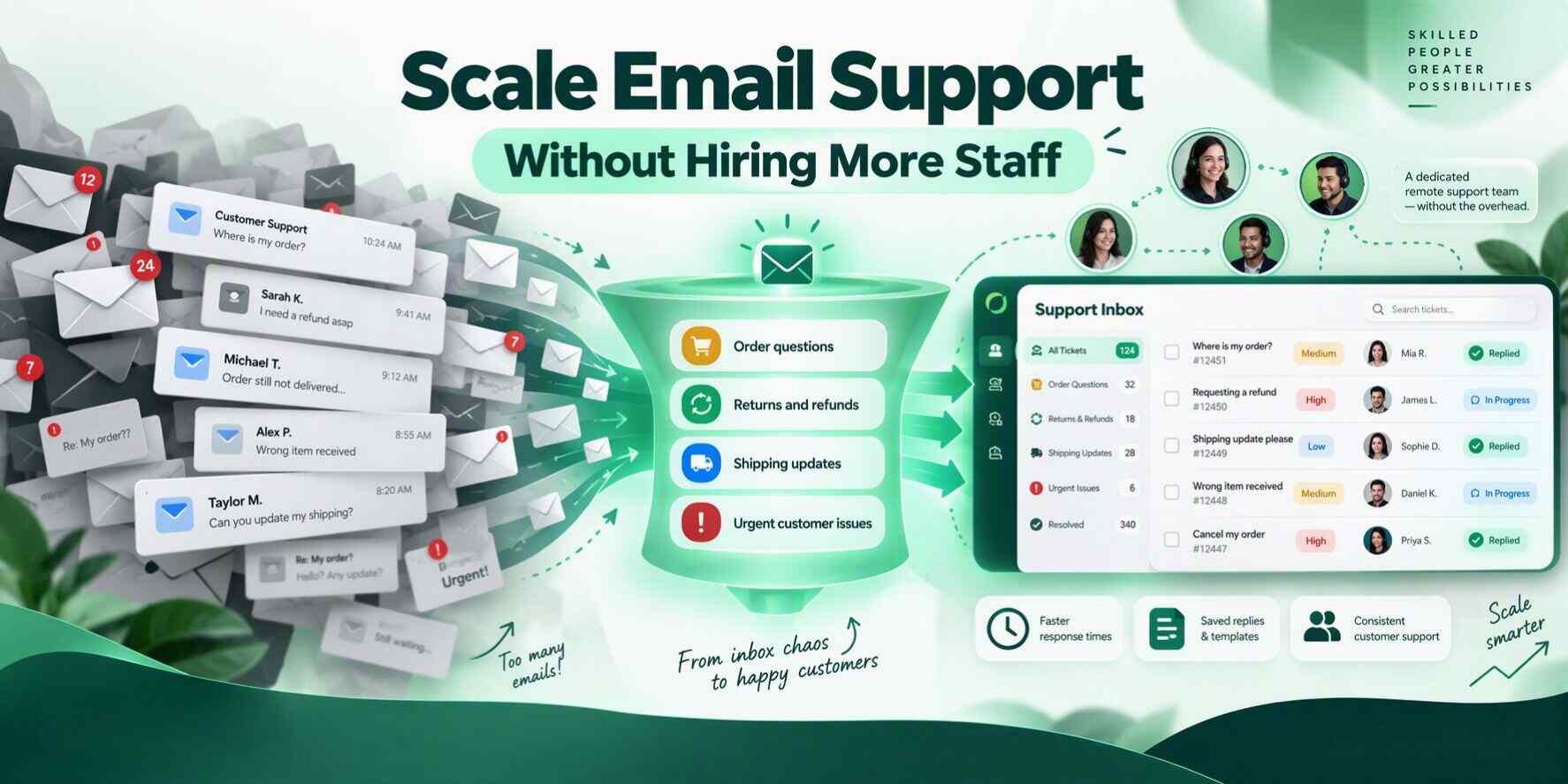
Nobody plans to build a support team. It sneaks up on you. First you answer a few customer emails yourself, then a few dozen, then you're answering them at 11 pm and wondering when this became your job.
So you decide to go the traditional route and bring people on board. And that's when things really get complicated: the job ad, screening the CVs, the marathon interviews, the offer, sorting out their pay, and getting them set up with a laptop and some training. Then you just have to hope they stick around.
Read through business forums and Q&A threads, and you'll see the same complaints everywhere. Hiring is slow. Agents leave. HR takes over the week. The budget never matches the invoice. And a lot of owners simply don't believe an outside team can sound like them.
Here's what this guide does. It compares in-house customer service with outsourced customer service on those exact complaints, adds a third option that many owners haven't considered, and points out where the rules differ in the USA, UK, UAE, Canada, and Australia. You'll come away knowing which model fits your business and which one to rule out.
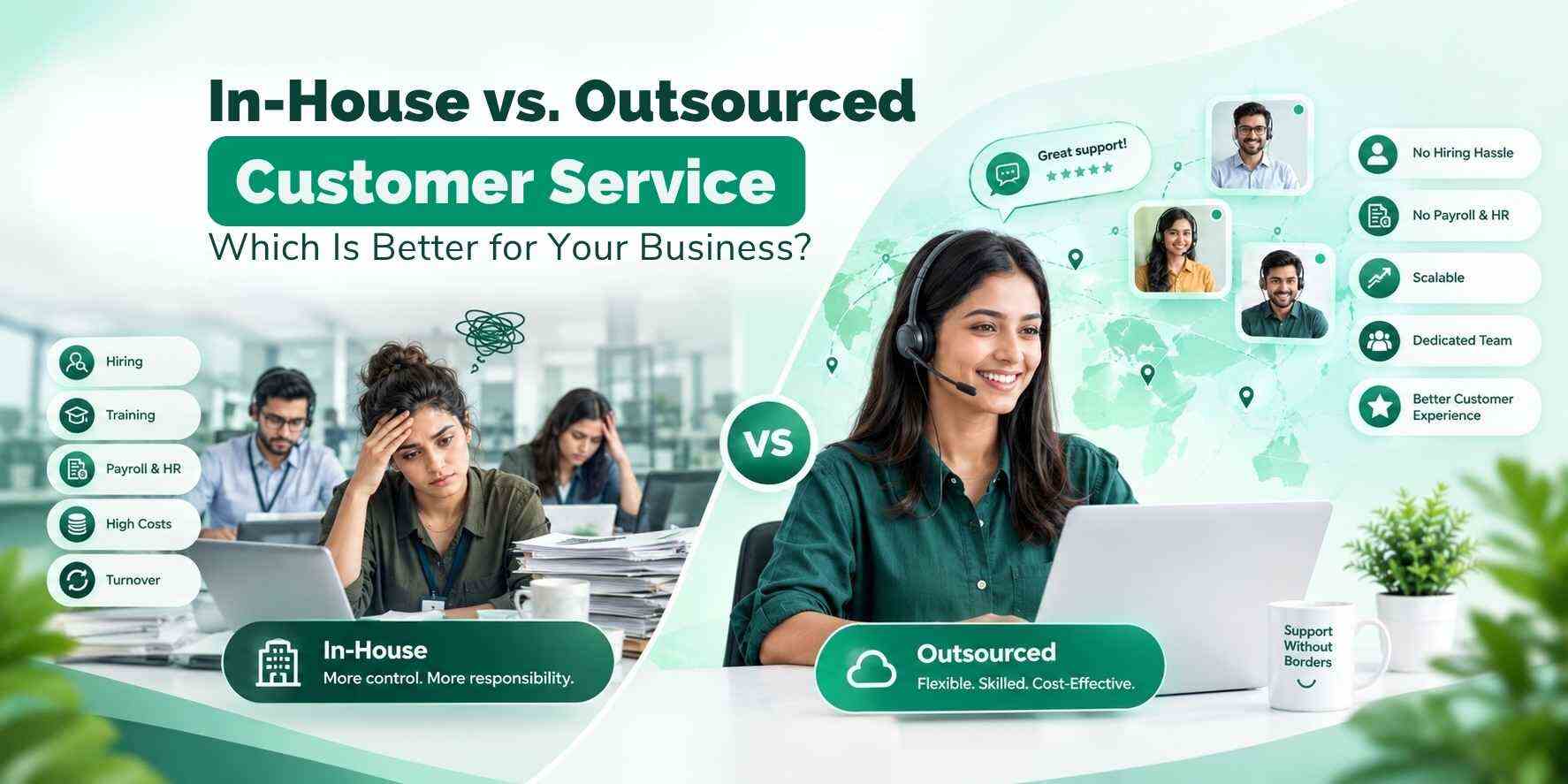
What is the difference between in-house and outsourced customer service?
In-house customer service: your own employees, on your payroll, dealing with your customers. You pay them, train them, and manage them.
Outsourced customer service: another company provides the staffing. That can be a massive call centre (think a big BPO) where the same agents handle loads of different brands, or a provider that places remote agents who work only for you.
The practical difference comes down to one question: who is the employer? If it's you, you get control, and you get the paperwork. If it's the provider, the paperwork goes away, but sometimes so does your influence over who picks up the phone.
Managed remote staffing was designed to solve that exact problem. We'll get to it.
The real cost of building an in-house customer service team
Most budgets stop at salary. That's the mistake. A cost breakdown from one outsourcing vendor estimates that running support in-house costs 25 to 40 percent more than salaries alone. It's one source, so I wouldn't quote it as gospel, but the direction is right. The extras always add up.
Hiring and training take longer than planned
Count the steps. Post the role. Read applications. Interview. Check references. Wait for the notice period to end. Train. Each step takes longer than you'd hope, and the total often stretches into months.
Say you're hiring ahead of a holiday sale. By the time your new agent is confident on live chat, the sale could be over.
Turnover is the cost nobody puts in the spreadsheet
Support is draining work. Agents get worn out from the same questions over and over and dealing with irate customers all day — and before you know it, some decide to call it quits. Then you're back where you started, finding and training another new hire. Add the hit to response times, and your remaining agents pick up the slack, which only makes them more likely to leave too.
HR, payroll, and workplace costs pile up
Every country has its own version of the same headache.
- USA: Payroll taxes, health insurance, workers' comp, and state rules that don't align with each other.
- UK: Employer National Insurance, pension auto-enrolment and statutory holiday pay — all the essentials.
- UAE: Visas, labour cards, WPS-compliant payroll, and end-of-service gratuity.
- Canada: CPP and EI contributions, each province's employment laws, and vacation accrual.
- Australia: Superannuation, leave loading, and complying with awards and contracts.
And then comes everything physical. Desks, laptops, licenses, internet, an HR tool. None of it is huge on its own. Together it's a department.
Your own time gets spent too
Who builds the schedule? Who approves leave? Who runs the performance review nobody wants to do? In most small companies, the answer is the owner. That's time you aren't spending on customers, product, or sales.
Support swamping you, but hiring feels like a trap?
Get dedicated agents without running payroll or HR yourself. Tell us your volumes and hours — we'll send pre-vetted customer support profiles in 48 hours.
Where outsourced customer service works well
There's a reason outsourcing has grown so much. Here's what it does well.
- It's fast: Third-party customer service solutions come with trained agents and working processes. You don't wait through a full hiring cycle. For a business with no HR function, that matters.
- It covers odd hours: A customer in Sydney doesn't care that it's 3 am in Chicago — they just want their issue sorted. Outsourcing makes 24/7 support possible without your own staff working ridiculous hours.
- It flexes: Retailers often need ten people in November and only three in February. Outsourcing makes that much easier.
Where outsourcing falls short
Plenty of articles skip this part. I won't, because the complaints you see online are often fair.
- Agents may not know your business very well: At a shared call centre, agents juggle multiple brands in one day. They might have the basics, but that doesn't mean they get what you deal with day to day.
- Customers can tell when an agent is just following a script: Scripts can be useful, but when the one they're using misses the mark, it's a poor experience. There's a big difference between a script written for a different scenario and one tailored to the customer's problem.
- Your brand voice can get lost: Friendly or professional, a consistent tone takes time to build, and when you're sharing a team with other brands it can get lost in the mix.
- Getting to the right person can be hard: If something's gone wrong, you often can't go back to the agent who handled it — you deal with an account manager first, which adds friction.
- The cost can change when your workload changes: Paying per ticket or minute looks reasonable in quiet times, but when business takes off your support bill can jump fast, especially in a busy period.
- That doesn't mean you should avoid outsourcing: It can still be a lifesaver — saving time and taking pressure off your team — as long as you choose a setup that fits how your business actually operates.
- A shared call centre isn't the same as a dedicated remote team: In a shared service, agents drift between brands all day. With a dedicated team, the people you work with get to know your company, your products and the people they're talking to.
None of this is to say outsourcing is a bad call — not by a long shot. It means one size does not fit all. A generic shared call centre and a dedicated team of remote workers are two very different things.
In-house vs. outsourced customer service: quality, control and scalability
| Factor | In-house team | Traditional outsourcing (BPO) |
|---|---|---|
| Brand knowledge | Strong over time | Varies, often shallow |
| Control over agents | Full | Limited |
| Time to start | Weeks to months | Days to weeks |
| Scaling up or down | Slow and costly | Fast |
| HR and payroll burden | All yours | Provider's |
| Cost predictability | Salary plus hidden costs | Depends on pricing model |
Here's the trade-off in plain terms. In-house gives you control but eats your time. A BPO saves time but can cost you consistency. If you want both, you need something else.
A third option: managed remote staffing for customer service
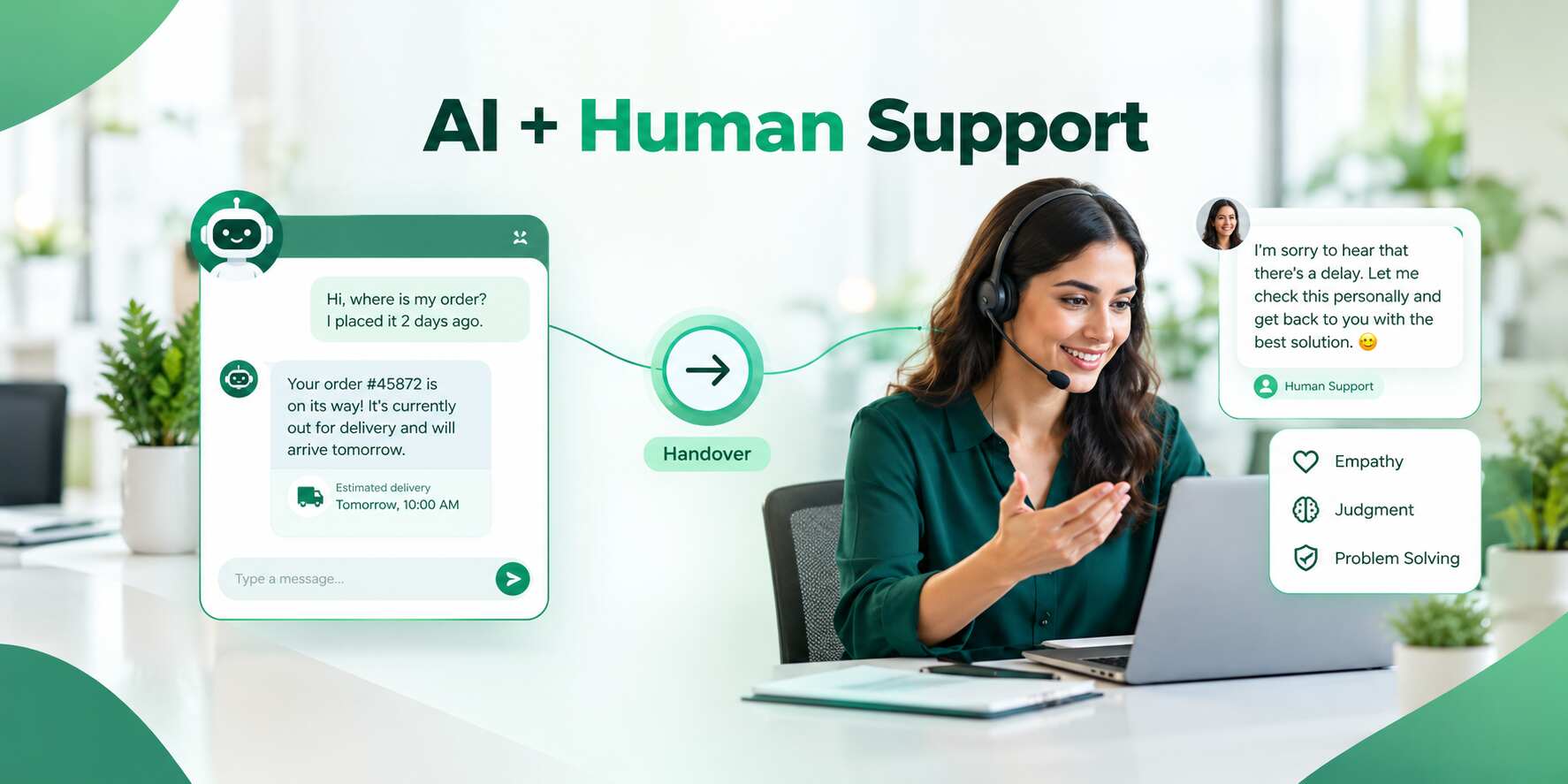
With managed remote staffing, the agents are dedicated to your business, and a staffing partner acts as their employer.
So they join your channels, learn your product, use your scripts, and take direction from your managers. You just never touch their contracts, payslips, or leave forms. The provider covers recruitment, HR, payroll, attendance, workplace needs, and employee administration.
The Remote Staff provides this to companies in the UAE, USA, UK, Canada, and Australia. Under its fully managed team model, its staff are employed by the company but work only for the client. Your side is the customer service work. Theirs is the people side.
The split is easy to remember:
- You decide: priorities, scripts, tone, escalation rules, daily tasks.
- The Remote Staff handles: hiring and recruitment, HR, payroll, attendance tracking, equipment and workplace, employee administration.
There's a case study on the company's website worth a look. A UAE business, GGS, hired three e-commerce specialists as a trial. The company has built up a team of 23 now — not a single HR or admin staff member on their payroll — and all they get is a single monthly invoice. It shows the typical path: start small, test it, then scale up if it works out.
How the three models compare
| In-house team | Traditional outsourced (BPO) | The Remote Staff (managed remote staffing) | |
|---|---|---|---|
| Who the agents work for | You only | Many clients | You only |
| Hiring and recruitment | You | Provider | Provider (shortlist in about 48 hours) |
| HR and payroll | You | Provider | Provider |
| Attendance and admin | You | Provider | Provider, with time tracking and daily reports |
| Workplace and equipment | You | Provider | Provider |
| Managing daily work | You | Often the provider | You |
| Time to start | Weeks to months | Days to weeks | About 1 to 2 weeks |
| If someone leaves | You restart the search | Provider reassigns | Free replacement |
| Typical cost | Salary plus overhead | Per ticket, minute or seat | One monthly fee per person |
On price: the company lists starting rates of AED 1,799, US$1,499, £799, CA$1,899 and A$2,499 per month for each dedicated team member, and claims savings of up to 70 percent compared with the fully loaded cost of hiring the same role locally. Those are starting figures. Your actual price depends on the role, seniority, and hours, so ask for a quote.
Why choose The Remote Staff for customer support outsourcing
If you're comparing customer support outsourcing with hiring locally, these are the practical points in favour of a managed model.
- Less time spent hiring. The company recruits from the open market and sends you a vetted shortlist. You interview people instead of reading CVs. For its customer support agent role, the site lists about seven days to hire.
- Screening is done up front. The process includes AI matching, recruiter checks, proctored assessments, and reference checks. You can also pay for a trial task if you want to see someone work before you commit.
- Compliance isn't on your plate. Contracts, statutory contributions, UAE gratuity and end-of-service, plus local rules elsewhere, are the provider's job.
- Someone keeps watching after the hire. Monthly one-to-ones, daily activity reports, and time tracking come with the service. Handy when your agent works in a different time zone.
- Turnover hurts less. If a hire doesn't work out, the company says it replaces them for free and handles the exit.
- It's easy to test. One specialist, then a full team, or eventually your own offshore office.
One caution. Dedicated remote agents still need good documentation, real onboarding, and regular feedback from you. A managed provider takes the admin away. It doesn't lead the team for you.
How to decide: a quick checklist
- Stay in-house: If you've got a highly technical or heavily regulated product, or customers who demand face-to-face service, then possibly.
- Choose a BPO: If you need a high-volume team covering simple questions and don't mind your brand voice taking a back seat.
- Choose managed remote staffing: If you want people dedicated to learning your product, but don't have the resources or inclination to run an HR department or build a full payroll function.
Many companies end up with a mix — an in-house lead for the tough issues and a dedicated remote team for the day-to-day.
Frequently asked questions
Usually, yes. When companies are growing fast they need to add staff in a hurry, and in-house hiring can't keep up. Outsourcing or managed remote staff takes the recruiting and admin off your plate. If you want a team that knows your business without the HR burden, The Remote Staff can send pre-vetted profiles for customer support roles — no hiring costs — and give you clear pricing for your market, with no commitment.
It depends on the model and market, but the company lists starting rates of AED 1,799, US$1,499, £799, CA$1,899 and A$2,499 per dedicated team member per month, and claims savings of up to 70% versus the fully loaded cost of hiring the same role locally. Your actual figure depends on role, seniority and hours, so ask for a quote.
It can, when the agents are dedicated to you. If you're selling something highly complex that needs deep understanding, a local team might still be your best bet — especially if you're not in a rush and care most about people who really get it.
Speed and less admin. You don't deal with the drudgery of recruitment, payroll, benefits and the costs of having someone on staff, and you don't start from scratch every time someone leaves. You still train agents on your product; the employment work around them stays with the provider.
A lot faster than going in-house with the usual ads, interviews, notice periods and ramp-up. A managed provider has a pool of pre-screened candidates. The Remote Staff quotes a shortlist in about 48 hours and a new person on board one to two weeks later, depending on how fast you interview.
Mainly cost, hiring difficulty, and the need for longer coverage hours. Many owners also want time back for customers and product rather than payroll and HR. Managed models appeal because you get dedicated staff without the employer duties.
Conclusion
In-house support gives you the control you want — but it brings a slew of headaches along with it: recruitment, turnover, payroll, office expenses and all the other administrative work.
A traditional BPO takes that admin load off your plate, but can quickly eat away at service quality and the consistency of your brand voice. The sweet spot is the middle ground: with managed remote staffing, agents work for you, but all the employment headaches are handled by someone else.
Want dedicated agents without the HR headache?
We build you a customer support team that works only for you — using your tools, in your voice — while we handle hiring, payroll and compliance. Shortlist in about 48 hours.