At some point, every growing business hits the same wall. Marketing needs more attention than anyone in-house has time for, but hiring a full internal team feels like a big leap too early. That is usually when the search starts: do you bring on a digital marketing freelancer in the UAE, or go straight for a dedicated remote marketing team?
There is no one-size-fits-all answer. It depends on where your business actually is right now, not where you hope to be in a year. This guide breaks down the real differences between the two, what each one is genuinely good at, and how to work out which fits your situation.
The short version
- Hire a freelance marketer when you need one specific skill done well, on a flexible budget, with no long-term commitment.
- Hire a dedicated remote marketing team when marketing spans several channels that need to work together and has become a genuine revenue driver.
- The cost gap is real, but the bigger cost is usually the opportunity you miss by choosing the wrong setup for your stage.
What's the real difference between a freelancer and a remote team?
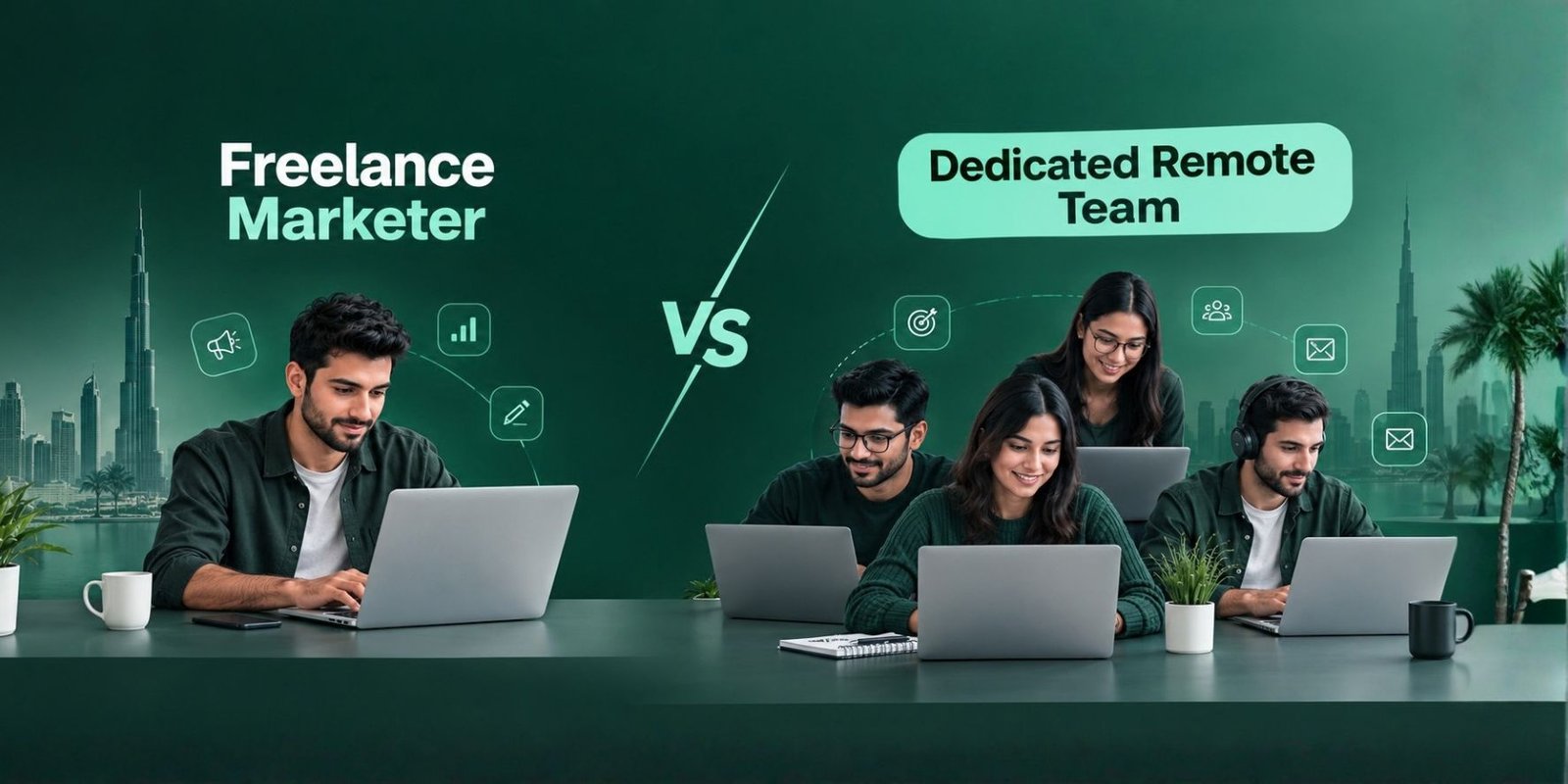
A freelance marketer in the UAE is usually a solo operator who does one or two things exceptionally well — social media, paid advertising, or copywriting. You get that specific skill set and whatever hours they can give you, which are typically spread across several clients at once. Your project is rarely their top priority, and that is not a criticism of freelancers; it is simply how the model works.
A dedicated remote marketing team, on the other hand, is a group of people each bringing a different specialism — strategy, writing, ads, design, analytics — working together as one unit that functions like an extension of your own company, minus the office space.
The difference is not only headcount. It is coordination. A freelancer delivers a task. A team delivers a marketing function.
Why this decision matters more than it seems
Getting this wrong does not just cost money. It kills momentum at exactly the point where you need it most.
Hire a freelance marketer for a job that really needed a full team and things start to come apart quietly. Nobody is handling the big picture. Nobody is connecting the ad campaign to the blog posts to the email sequence. One person is doing their piece in isolation while the rest of the strategy drifts.
Go the other way and hire a dedicated marketing team when a good freelancer would have covered it, and you are paying for capacity you do not need yet — plus the coordination overhead that comes with it. The work gets done well, but the results do not justify the outlay.
Not sure which one your business actually needs?
Tell us your channels and budget. We'll say honestly whether one specialist or a full team fits — even if that means fewer people.
When a freelance marketer makes sense
Freelancers suit businesses that need a specific piece of work done to a high standard without the ongoing commitments that come with building a team. A single freelancer can run your Instagram content, launch a few Google Ads campaigns, or produce regular blog posts on a steady schedule.
This setup works best for:
- Early-stage businesses testing whether marketing moves the needle at all
- Solo founders who need one channel handled properly while they focus elsewhere
- Companies with a defined, short-term project — a launch, a rebrand, a seasonal push
- Teams with an in-house marketer who needs specialist support in one area
The appeal is flexibility. You scale up or wind down on your terms, with no long-term commitment hanging over you.
Where a freelancer starts to fall short
Capacity is the catch. One person can only do so much. Once your marketing needs stretch across social media, paid ads, email, SEO and content, a single freelancer gets spread thin — or you end up sourcing and coordinating several freelancers separately, which quietly becomes your job rather than theirs.
When a dedicated remote marketing team makes more sense
Once a business has multiple campaigns running across different channels, and marketing has become a real revenue driver rather than a nice-to-have, a dedicated remote team usually makes more sense than a single freelancer.
The main advantage is that everything is connected. The person running your ads knows what the content team is publishing. The email strategy lines up with what is happening on social. Nothing operates in its own bubble the way it can when separate freelancers handle separate channels without ever speaking to each other.
Consistency and cover
A team also solves a problem a single freelancer structurally cannot: continuity. If someone is ill, on leave, or buried in other work, the work does not stop. Someone else on the team already knows the account and can pick things up where they were left. That safety net is difficult to replicate with one person, however good or reliable they are — because at the end of the day, there is only one of them.
That is the reasoning behind a fully managed remote team: dedicated people who work only for you, with the hiring, payroll and cover handled on your behalf.
Cost comparison: what you're actually paying for
A freelance marketer in the UAE tends to be more cost-effective upfront. You pay for hours or a project fee, with nothing tying you in long term. A dedicated remote marketing team carries a higher overall price tag, but you are buying a combination of skills, project management and consistency that one person cannot match.
| Factor | Freelance marketer | Dedicated remote marketing team |
|---|---|---|
| Upfront cost | Lower — hourly or per project | Higher — a monthly team cost |
| Scope | One or two channels done well | Strategy, content, ads, SEO, email, analytics |
| Availability | Shared across several clients | Dedicated hours, working your schedule |
| Cover and continuity | Work pauses when they are unavailable | Built-in cover across the team |
| Coordination | You manage it | Managed within the team |
| Scalability | Limited by one person's capacity | Add specialists as needs grow |
| Best suited to | Early-stage and single-channel needs | Multi-channel, revenue-driving marketing |
The true cost difference goes beyond the invoice — it is in the missed opportunities. A freelancer can save money in the short term but cannot fill the gaps in your strategy. A team costs more but often pays for itself once the systems click and results start compounding. You can see how dedicated team costs are structured on our pricing page.
See what a dedicated marketing team would cost you
Send us the channels you need covered. We'll come back with a costed team and pre-vetted profiles within 48 hours.
Remote marketing services: what's actually included
Remote marketing services vary enormously depending on who is providing them. With a freelancer, it is usually one clearly defined service — content writing, ad management, or social media posting.
With a dedicated remote marketing team, the scope is far broader. You typically get strategy, content creation, paid advertising, SEO, email marketing, analytics and reporting, and sometimes branding and design, all under one roof rather than cobbled together piecemeal.
Common mistakes businesses make
Hiring one freelancer for work that needs a team. Cramming five marketing channels onto one freelancer's plate rarely ends well. Either give each channel someone who can own it properly, or bring in a team that already covers them.
Jumping to a full team too soon. Committing to a team before you know you need one adds cost without adding much value. Prove the channel first, then scale the resourcing behind it.
Leaving work management undefined. Whether you hire a freelancer or a full team, unclear communication and reporting structures cause more problems than the marketing work itself. Agree on the reporting rhythm before day one.
How to choose the right fit for your business
- Start with a freelancer if you need one specific skill done well, on a flexible budget.
- Move to a dedicated remote marketing team once your marketing spans multiple channels that need to work together.
- Ask any remote marketing professionals you are considering — freelance or team — for examples of past work in your industry, not just a general portfolio.
- Set expectations upfront: deliverables, reporting frequency, and how communication will work.
- Reassess every few months. What fit your business at launch may not fit it a year later.
Frequently asked questions
A freelancer is typically one person handling a specific task, like content or ads. A dedicated remote marketing team is a group covering multiple areas together — strategy, content, ads and reporting — working as a coordinated unit rather than in isolation.
It depends on your stage and needs. A freelancer suits businesses needing one specific service on a flexible budget, while a team fits businesses running multiple coordinated campaigns that need everything working together.
Costs vary widely based on experience and scope — some freelancers charge hourly, others per project. Generally, freelancers cost less upfront than a full remote team, since you are paying for one person's time rather than a coordinated group.
Usually once marketing spans multiple channels that need to work together — ads, content, email, SEO — or once a single freelancer's bandwidth can no longer keep up with what the business needs.
Most teams cover strategy, content creation, paid advertising, SEO, email marketing and analytics, often alongside design or branding support — essentially the full range a business would otherwise need multiple freelancers to cover separately.
Look at past work in your specific industry, ask how communication and reporting will work, and make sure their service scope actually matches what your business needs rather than a generic package.
The bottom line
There is no universally correct answer between hiring a freelancer and building a dedicated team. It comes down to what fits your business right now. A freelancer works well when you have a focused set of needs and a tight budget. A dedicated team is the right call when your marketing has several moving parts that need to stay in sync.
The businesses that get this right are not the ones that pick the "best" option. They pick the one that suits where they are today, then revisit the decision as they grow. If you are weighing it up, tell us what you need and we will show you what a dedicated marketing team would look like for your stage.


