User query
"What is staff outsourcing in the UAE, how much does it cost, and how can a business build a dedicated offshore team?"
Adding one new employee in the UAE isn't usually a quick process. There's visa sponsorship, WPS payroll registration, MOHRE paperwork, and the actual work of finding and screening people. By the time someone starts their first day, a business can easily have burned a few weeks of internal time just getting them there.
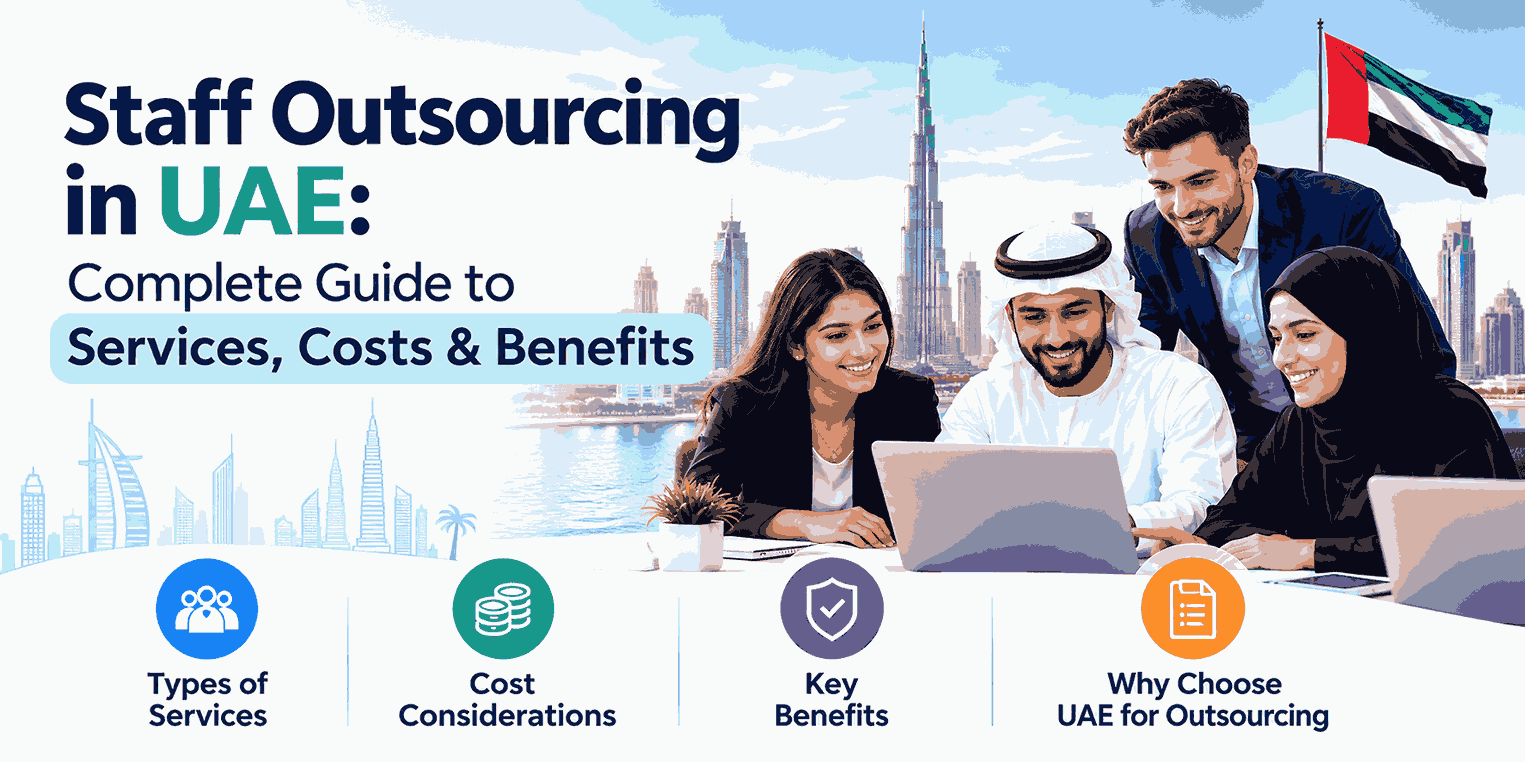
Staff outsourcing exists to take that load off. An external partner handles the recruiting, employment and management side of things, while the client still decides what the person actually works on day to day. This guide covers how it works, what's usually included, roughly what it costs, how it stacks up against agencies and freelancers, who tends to handle payroll and compliance, and what to ask before signing with a provider.
What Is Staff Outsourcing in the UAE?
Staff outsourcing means a business hires an outside partner to recruit, employ, or manage staff who work for that business — while the client keeps day-to-day control over the employee's work. What exactly the partner is responsible for depends on the contract and, sometimes, on local rules that apply to that specific setup.
Put simply: rather than running recruitment, payroll and HR entirely in-house, a company hands those admin layers to a partner. The employee is still working only for that client and taking direction only from that client — the partner just deals with what happens behind the scenes.
How Does Staff Outsourcing Work?
- The business figures out which role it needs filled.
- The partner asks about specifics — skills, hours, seniority, tools.
- The partner sources and screens candidates.
- The client interviews and picks who they want.
- The employee gets onboarded.
- The partner takes care of whatever employment, payroll, HR and compliance tasks were agreed on.
- The employee works to the client's hours and processes.
- The team grows or shrinks as the business needs change.
Who's responsible for what isn't standard across the board — worth getting that in writing before you sign anything.
Staff Outsourcing Services: What's Included?
Recruitment and Candidate Screening:
Sourcing, first-round vetting, skills checks, shortlisting — the work that happens before a client sees a single profile.
Dedicated Full-Time Staff:
A freelancer or an agency temp might be splitting time across several clients. Dedicated staff isn't — they work for one business only, which tends to matter for roles where consistency and context actually build up over months, not just tasks.
Payroll and HR Administration:
Salary processing, leave tracking, general HR admin — usually run by the partner rather than the client's own team.
Compliance and Employment Administration:
Providers can take on agreed compliance tasks tied to employment. This isn't a fixed, industry-standard package though — it changes from provider to provider, so it's worth asking exactly what's covered.
Performance and Team Management:
Some setups include ongoing check-ins, retention support, or performance reviews. Again, this comes down to what's in the agreement.
Want this mapped to the roles you actually need?
Tell us the functions you're trying to cover. We'll come back with who does what, what sits with us, and what stays with you — in writing.
Staff Outsourcing vs Other Hiring Models
| Model | Recruitment | Dedicated Staff | Payroll/HR | Client Controls Daily Work | Typical Use |
|---|---|---|---|---|---|
| Local hiring | Client/provider | Yes | Client | Yes | Local in-house team |
| Freelancer | Marketplace/direct | Usually no | Usually client | Yes | Short-term or specialist tasks |
| Staffing agency | Agency | Depends | Depends | Depends | Temporary or placed staff |
| Staff outsourcing | Outsourcing partner | Can be yes | Provider or contract dependent | Usually yes | Building dedicated teams |
| Dedicated offshore staffing | Provider | Yes | Provider | Yes | Long term remote teams |
Contracts aren't identical across providers, so treat this as a general shape rather than a fixed rulebook. If the employment relationship itself is what you are trying to solve, our guide to EOR in the UAE covers that model specifically.
Why UAE Companies Consider Staff Outsourcing
The usual reasons: a bigger talent pool to pull from, lower hiring overhead, teams that come together faster, less internal HR work, staff who aren't shared with other clients, and costs that are easier to predict month to month. Businesses use this to staff digital marketing teams, customer support, e-commerce operations, dev teams, back-office and finance support, and sales or lead-gen functions.
How Much Does Staff Outsourcing Cost in the UAE?
There isn't one number for this cost moves with the role, seniority, required skills, hours, team size, where the staff are based, how much management is included, the employment structure, and any equipment needs.
Two figures tend to get mixed up and are worth separating:
- Total employee cost — the salary and statutory costs tied to the role itself.
- Outsourced staffing fee — what you pay the partner to manage sourcing, employment, payroll and HR.
Some providers, including The Remote Staff, publish their own indicative pricing on request. That reflects one company's current rates — not a market-wide average — so it's better treated as a reference point than a benchmark.
Traditional Hiring vs Staff Outsourcing
The traditional route: write the job description, post it, sort through applications, screen, interview, negotiate salary, do the paperwork, set up payroll, onboard, then keep managing HR going forward.
There's nothing wrong with this — plenty of businesses hire this way and it works fine for them. It just tends to take longer, draws from a smaller pool of local candidates, and puts recruitment costs, payroll admin and compliance work onto the client's own team. Scaling a team quickly through this route alone can also be harder than people expect.
Dedicated Offshore Staffing: A Different Approach
This goes a step past freelancing. The employee works full-time for one client, on that client's hours, taking direction from that client. The Remote Staff says it manages hiring, payroll, and compliance and HR admin in the background, so a business can start with one hire and build out a full department from there. It's people running the employment relationship — not software automating it.
How The Remote Staff Model Works
- Tell us what you need: role, skills, hours, what you're trying to achieve.
- Get pre-vetted profiles: the company says this usually takes around 48 hours.
- Interview candidates and pick who fits.
- Start working: the employee joins your workflow.
- We handle the back office: payroll, HR, compliance, employment admin, based on what was agreed (this isn't identical for every client).
What to Check Before Choosing a Staff Outsourcing Company
- What's actually covered by the monthly fee?
- Who employs the staff, and who runs payroll and HR?
- How are candidates vetted — and can you interview them yourself?
- Are they working for you alone, or split across clients?
- What happens if someone isn't working out — is a replacement included?
- What are the contract terms, and are there hidden fees?
- How fast can the team realistically get started?
- Which countries and time zones does the provider actually cover?
- What roles is the provider genuinely good at?
- How is performance tracked once someone's on the team?
Staff Outsourcing for Different Business Functions
Digital Marketing Staff: SEO specialists, content marketers, social media managers, PPC and performance marketers, lead-gen specialists, marketing analysts roles for which dedicated offshore staffing is commonly used to fill.
E-commerce Staff: E-commerce managers, marketplace specialists, Shopify or WooCommerce developers, ads specialists, catalogue executives, customer support, inventory and order management.
Other departments can be staffed this way too — depends on what a given provider actually supports, so it's worth checking rather than assuming.
Still not sure which model you actually need?
Outsourcing, EOR or a direct hire — message us on WhatsApp and we'll tell you straight, even if the answer is none of them.
Frequently Asked Questions
An external partner recruits, employs and/or manages dedicated staff for a UAE business, while the client keeps control of the day-to-day work. The partner usually handles sourcing, onboarding, payroll and HR, though the exact split depends on the contract.
It depends on the setup. Some arrangements have the outsourcing partner acting as the formal employer of record; others keep the client as the sponsoring employer while the partner runs support functions. Confirm this before signing — UAE work permits and visas need a clearly identified sponsoring entity registered with MOHRE.
Recruitment generally stops once someone's hired — after that, the client runs employment, payroll and HR on their own. Staff outsourcing keeps going past that point, with the partner handling agreed employment tasks on an ongoing basis rather than charging a one-off placement fee.
It depends on the role, seniority, hours and scope of services, so there's no fixed industry price. Businesses typically pay for the employee's compensation plus a service fee to the outsourcing partner. A provider's published rate reflects that company, not the wider market.
A work permit and residence visa need a registered sponsoring employer approved by MOHRE and immigration authorities. Depending on the arrangement, that sponsor is either the outsourcing partner or the client entity — worth confirming rather than assuming.
UAE-registered employers have to pay salaries through the Wages Protection System, run jointly with MOHRE and the Central Bank. Whichever entity is the registered employer is on the hook for WPS compliance — in a lot of outsourcing arrangements, that's the outsourcing partner.
Yes, as long as that third party is properly registered and compliant with MOHRE requirements. That said, "staff outsourcing," "EOR" and "staffing agency" aren't interchangeable legal terms — worth clarifying which model a given provider is actually running.
Yes, provided the entity acting as employer is properly registered and compliant with MOHRE and immigration rules. Legality comes down to the specifics of the setup, not the word "outsourcing" itself — check a provider's registration and compliance practices directly rather than taking the label at face value.
Conclusion
Staff outsourcing lets UAE businesses build teams without taking on every administrative step of local hiring themselves. Recruitment, payroll, compliance and HR sit with a partner; the client keeps control over the actual work. What sets it apart from freelancing or traditional agencies is mostly depth — staff are dedicated rather than shared, and the relationship's usually built to last rather than cover one gig or placement.
Before picking a provider, get clear answers in writing on who employs the staff, how payroll and compliance are actually handled, and what happens if a hire doesn't work out. If you're weighing whether dedicated offshore staffing fits your team, The Remote Staff can talk through your specific needs and what a remote staffing setup would look like in practice.


